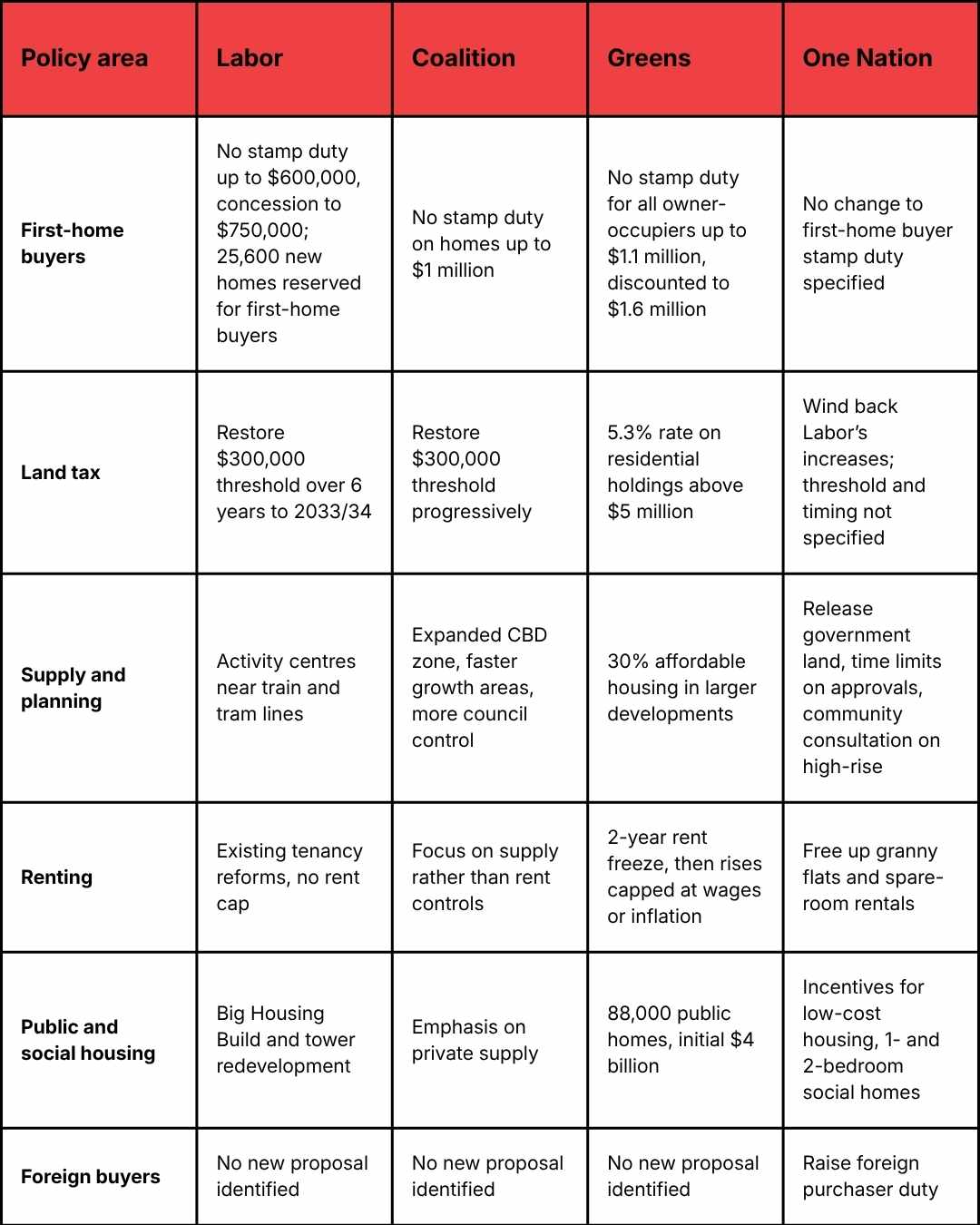
In August, we compared the housing policies of the Victorian Labor Party, the Liberal–National Coalition, and the Victorian Greens ahead of the Victoria State Election 2026 on Saturday 28 November. You can read the full detail in our comparison of Labor, Coalition and Greens housing policies.
At the time, One Nation hadn’t released a state housing plan. One Nation’s housing policy for Victoria has since been published, and Labor has made two housing announcements that change the picture we described. This update covers what’s new, with links to each party’s own material so you can read the details yourself.
The short update
- One Nation has released its housing policy, focused on cutting government charges on new homes, speeding up approvals and raising duty for foreign buyers.
- Labor now plans to restore the $300,000 land tax threshold by 2033/34, so Labor, the Coalition and One Nation all propose the same end point.
- Labor has also committed to 25,600 new homes reserved for first-home buyers, with the first lot expected in 2027.
One Nation’s housing policy for Victoria
One Nation Victoria, led by Warren Pickering, released its election platform, The Real Deal for Victoria, in October 2026.
Its housing commitments focus on reducing the government-imposed costs of building and holding property, freeing up existing housing stock and limiting competition from overseas buyers.
The party attributes much of the pressure on rents to population growth driven by net overseas migration.
Costs and taxes
- To review every government fee, tax and charge that adds to the cost of a new home, and cut those it considers no longer justified.
- To wind back Labor’s land tax increases on rental properties and small property owners.
- To abolish the 10% stamp duty on home, contents and car insurance.
Housing supply and planning
- To release under-used government land for housing.
- To put a legal time limit on planning and building approvals.
- To offer incentives for private and community organisations to deliver more low-cost housing.
- To require community consultation before high-rise development in established suburbs.
Existing homes and foreign buyers
- To remove restrictions on renting out granny flats and spare rooms, modelled offpointing to South Australia’s rules as a model.
- To raise the foreign purchaser duty, the extra stamp duty foreign buyers pay on residential property in Victoria.
Social housing and homelessness
The following measures come from One Nation’s separate homelessness policy.
- To trial land tax exemptions for landlords who lease homes to the state or community housing providers for 12-month tenancies.
- To build a pipeline of 1- and 2-bedroom social and affordable homes for singles, people over 55 and women leaving violence.
What One Nation’s plan doesn’t specify
Some details aren’t set out in the published platform.
For example, One Nation do not specify a new foreign purchaser duty rate, a land tax threshold or timeframe, or any change to first-home buyer stamp duty. It also doesn’t include rent freeze or rent cap measures.
Labor’s land tax and first-home buyer changes
Land tax
In our previous article, we described Labor as holding current land tax settings. In October, Labor committed to restoring the general land tax threshold to $300,000, reversing the 2023 change that lowered it to $50,000.
Land tax is an annual tax on land you own other than your home, such as an investment property, and the threshold is the land value at which it starts to apply.
Under these proposed changes, the threshold would rise by $25,000 in each of 2027/28, 2028/29 and 2029/30, then continue rising until $300,000 is reached in 2033/34.
Labor puts the cost at $230 million over five years.
This means Labor, the Coalition and One Nation now all propose returning the threshold to $300,000, with differences in timing and detail. The Victorian Greens remain the only party proposing a higher land tax on investors, through a 5.3% rate on residential holdings above $5 million.
Homes reserved for first-home buyers
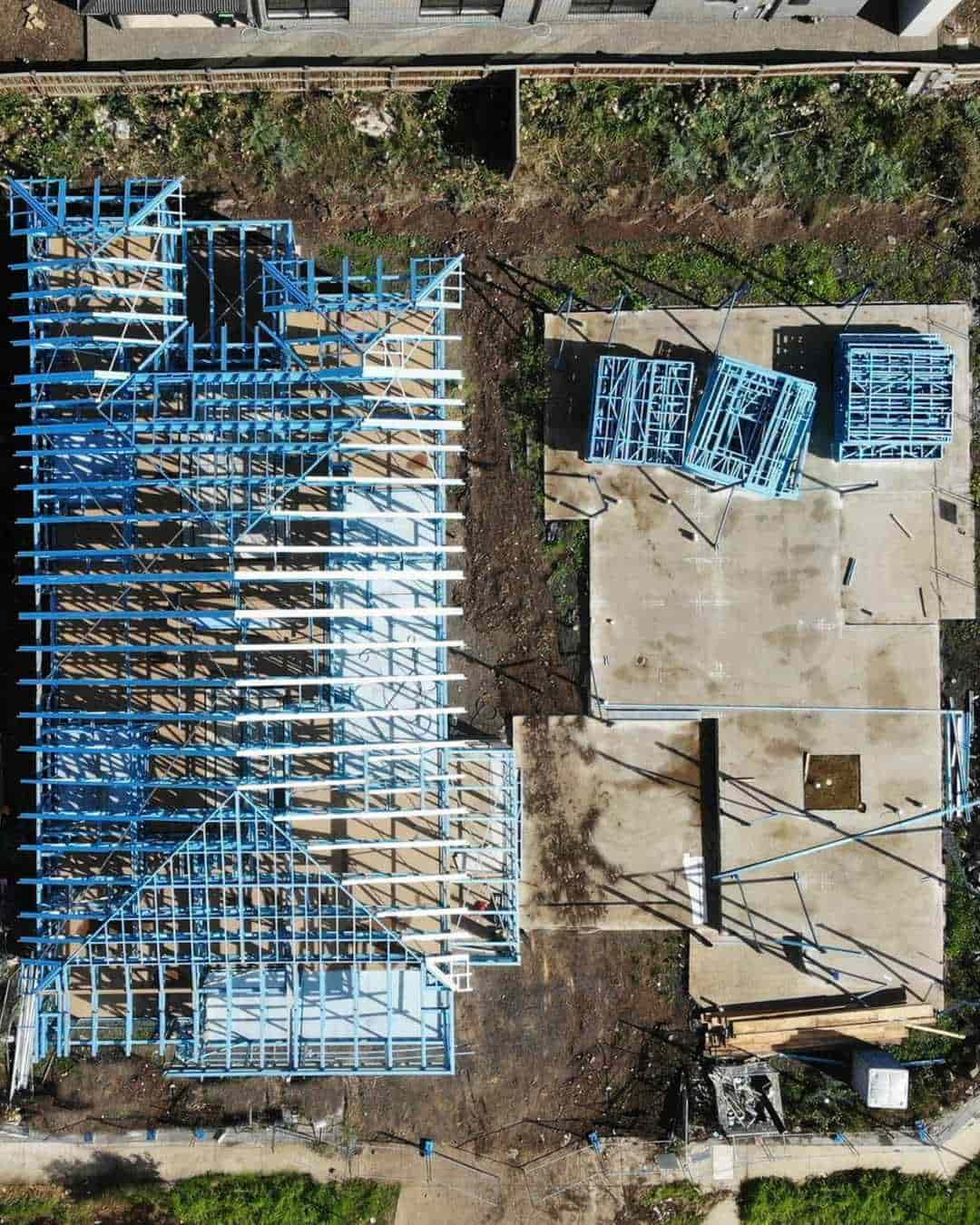
Labor has also announced plans to build 25,600 new homes in partnership with the Commonwealth and reserve them for first-home buyers for a period after completion.
The homes would be spread across more than 20 locations in Melbourne and regional Victoria, with the first lot expected in 2027. Labor describes it as a $499 million investment.
Labor’s first-home buyer stamp duty settings are unchanged from those we described previously.
The Coalition and the Greens
We found no change to the Coalition’s or Greens’ policies since our last article.
The Coalition’s campaign platform still commits to no stamp duty for first-home buyers on homes up to $1 million and to restoring the $300,000 land tax threshold. Its housing policy centres on faster growth-area development, an expanded Capital City Zone and a greater planning role for local councils.
The Greens’ housing and renting platforms also include a ban on street auctions with reserve prices disclosed when a property is advertised, an independent rental regulator with a landlord licensing scheme funded at $50 million, and a ban on rent increases in the first two years of every new tenancy.
What these housing policies mean for you
For first-home buyers, the clearest difference between the parties is still stamp duty, with thresholds ranging from Labor’s current $600,000 exemption to the Greens’ $1.1 million for all owner-occupiers. Labor’s reserved homes add a different kind of support, focused on access to new homes rather than upfront costs.
For property investors, land tax is now less of a dividing line, with three parties proposing a return to the $300,000 threshold. The main differences are timing and, for the Greens, a higher rate on residential portfolios above $5 million.
For renters, the Victorian Greens are still the only party proposing to freeze and cap rents. The other parties focus on increasing supply, and One Nation argues that lower land tax would ease pressure on rents.
As we noted in our earlier article, an election commitment doesn’t change your stamp duty, land tax or borrowing capacity until the relevant rules actually take effect.
Under both Labor’s and the Coalition’s plans, for example, land tax changes would be phased in over several years rather than all at once, and every proposal may need legislation before it applies.
If you’re buying, refinancing or holding an investment property, it can make sense to work from the rules and lending options available today, then consider how an announced policy might change the picture later.
You can talk it through with a UFinancial mortgage broker to understand what the current settings mean for your plans, and what to keep an eye on from here.
General advice disclaimer
This article provides general information only. It does not consider any individual’s objectives, financial situation or needs and is not personal financial, taxation or legal advice. Finance eligibility and conditions depend on the circumstances and lender.
UFinancial Planning representatives are authorised by Consultum Financial Advisers Pty Ltd, ABN 65 006 373 995, AFSL 230323. Other financial products and services provided by UFinancial Pty Ltd are not authorised by Consultum Financial Advisers Pty Ltd.
Housing policy snapshot as of 18 November 2026