
Housing will no doubt be a central issue in the Victoria State Election 2026, scheduled for 28 November.
Buyers are dealing with high prices, tighter borrowing capacity and steep upfront costs like stamp duty. Renters are managing higher rents and fewer choices. Investors are weighing higher property taxes and changing regulation. And Victoria, more broadly, simply needs more homes, in both established suburbs and growth areas alike.
The Victorian Labor Party, the Liberal–National Coalition and the Victorian Greens all agree that more housing is needed. What they don’t agree on is how it should be delivered, which costs government should raise or lower, and how much of the job belongs to private developers versus the state itself.
Warren Pickering’s One Nation has also attracted attention in Victorian polling this year but hasn’t yet released a detailed state housing plan to compare on the same basis.
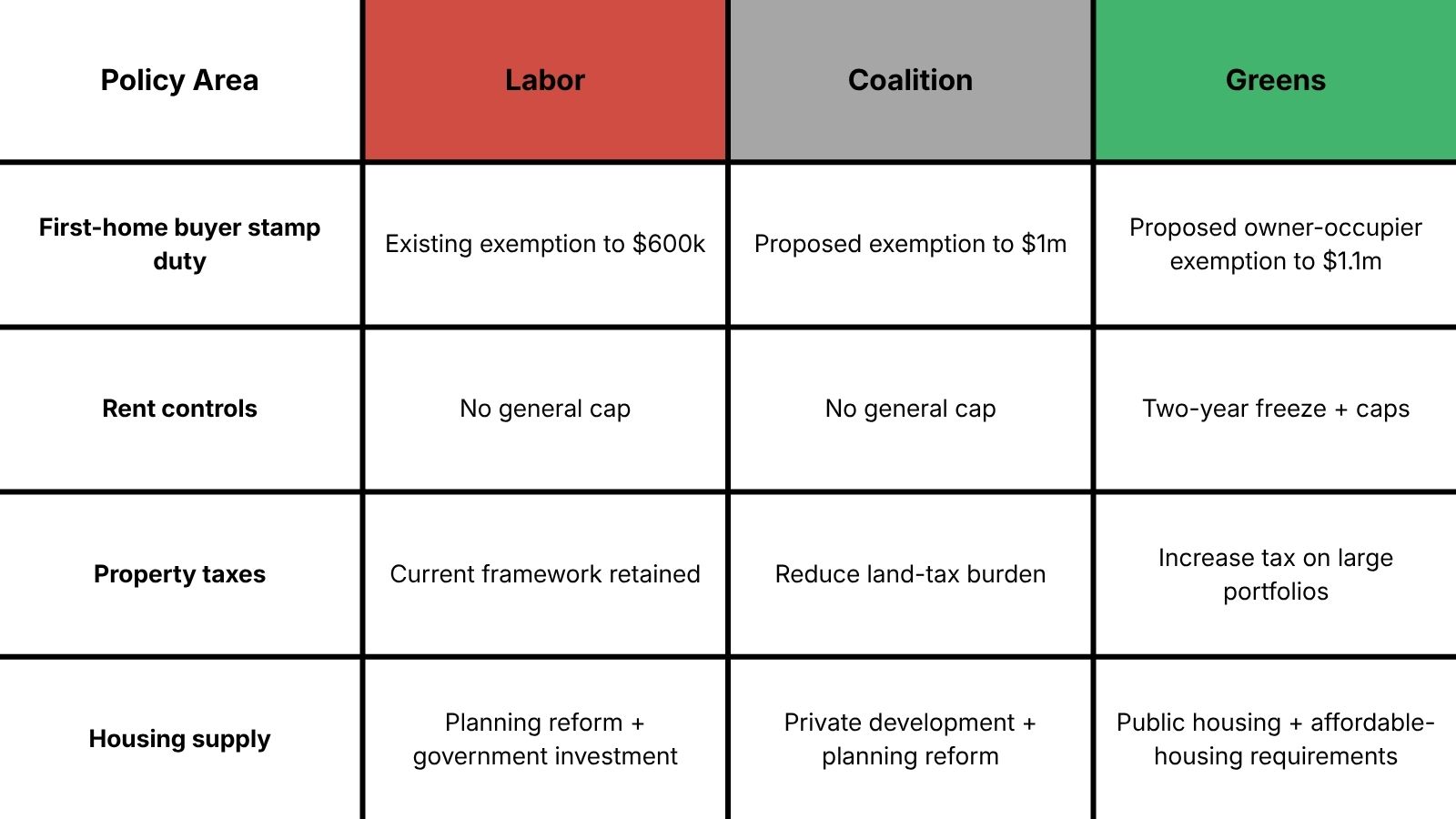
Housing policy snapshot as of 24 August 2026:
Buying a home: Which party is offering first-home buyers the most help?
First-home buyer activity is softening across Australia. Nationally, new owner-occupier loans fell 3.3% in the June 2026 quarter. First-home buyer loans fell 2.9% to 29,319.
Interest rate rises and significant Federal Budget changes are the most cited reasons. It’s a reminder that policy doesn’t just sit in the background; it shapes what actually happens in the market. The clearest difference in the parties’ proposals concerns stamp duty, the state tax paid when property changes hands, and often the extra cost buyers feel most acutely while juggling a deposit, legal fees, inspections and moving costs.
Victoria’s current stamp duty rules are:
- No stamp duty for eligible first-home buyers when purchasing a home valued at up to $600,000.
- A concession applies between $600,001 and $750,000.
- Eligible purchasers of a new home may also qualify for the $10,000 First Home Owner Grant where the property meets the applicable requirements.
The Victorian Government has separately extended its broader off-the-plan stamp duty concession for eligible apartments, units and townhouses until 21 April 2027. That concession is not limited to first-home buyers.
The Victorian Coalition wants to lift the first-home buyer threshold significantly, removing stamp duty on established or new homes up to $1 million. The Greens go further again, but differently: no stamp duty for owner-occupiers (not just first-home buyers) under $1.1 million, with discounted duty on a sliding scale up to $1.6 million
These thresholds could meaningfully change how much cash a Victorian buyer needs at settlement. What they won’t change is what you can actually afford, your borrowing capacity, repayment comfort, deposit and lender criteria still do the heavy lifting.

Addressing supply: Where homes should be built according to major parties
There is little disagreement that Victoria needs more housing. The real argument is where and how government makes it happen.
Under the current Labor Government:
- The activity-centre program covers dozens of train and tram locations and intends to create capacity for more than 300,000 homes close to transport, employment and services.
- The lan for Victoria targets roughly 70% of new housing in established areas and 30% in growth areas.
That means more apartments and townhouses in some existing suburbs, alongside continued greenfield development on Melbourne’s fringe and in growing regional communities.
The Coalition is pushing in a different direction:
- Greater residential density in Melbourne’s CBD and surrounding inner-city areas
- Faster development in certain outer growth areas
- A bigger planning role for local councils
- Clearing a backlog of Precinct Structure Plans, which are planning frameworks that determine how new outer-suburban communities will develop.
The Victorian Greens support additional private development too, but want strings attached:
- At least 30% affordable housing in projects of 15 or more dwellings
- Strong push for public-housing construction.
None of this is simply “for” or “against” building.
More density near transport puts people closer to jobs, but raises real questions about congestion, schools and open space. Growing the outer suburbs creates more land for detached housing, but new communities need roads, transport and services to match. And there’s the question of who decides. State-led planning makes it easier to coordinate across Melbourne, while council control hands more say to local communities, at the cost of consistency.
For buyers, these policies will shape what’s available, where, and how their suburb looks in ten years.
Renting: Differing ideas about controlling costs
This is where the parties diverge.
Labor has continued to strengthen tenancy regulation without introducing a broad rent freeze or price cap, increases are generally limited to once every 12 months, with extended notice periods and tighter rental-bidding rules layered in over time. Its new portable bond scheme is designed to let an eligible renter carry an existing bond across to a new property, rather than fronting a second bond while waiting on the first.
The Greens are proposing much stronger price intervention. Their policy includes an initial two-year rent freeze followed by permanent limits on rent increases, with rises capped by wages growth or inflation, whichever is lower.
The Coalition’s housing agenda is more focused on increasing supply, speeding development and reducing some ownership and investment costs than directly limiting rents.
A rent freeze can give covered renters immediate certainty about what they will pay. The counterargument is that stricter controls can reduce rental returns and may affect investors’ willingness to supply rental housing, depending on how a policy is designed and how owners respond.
Increasing the number of homes available instead, can reduce pressure when supply grows relative to demand, but planning approvals and construction take time.
For renters, that creates a fairly clear choice between policies designed to regulate costs more directly now and those relying more heavily on additional housing supply over time.
"For renters, that creates a fairly clear choice between policies designed to regulate costs more directly now and those relying more heavily on additional housing supply over time."
Election proposals for investors and property taxes
Property investors are watching a different set of numbers. Under Labor, Victoria currently operates a comparatively broad land-tax framework, including the temporary COVID Debt Repayment Plan surcharge and vacant residential land tax.
The Coalition wants to ease that, progressively restoring the general land-tax-free threshold to $300,000.
The Greens would move the other way for very large residential portfolios: a higher land-tax rate of 5.3% on residential holdings above $5 million, plus the removal of certain build-to-rent and absentee-owner concessions
These differences come down to how each party sees investment within the housing system.
- The Coalition wants to lower ownership costs and encourage private investment and development.
- The Greens want more housing revenue raised from investors with substantial residential holdings, redirected to lower stamp duty and public housing.
- Labor currently sits between the two, holding current settings while leaning on planning reform to lift housing supply.
Public and social housing: Who should actually build the homes?
Another major difference is the role government itself should play as a housing provider.
Labor’s pairs private development with substantial public investment. It points to The Big Housing Build as delivering more than 16,000 social and affordable homes, with over 12,000 complete or underway, alongside the redevelopment of Victoria’s 44 ageing public-housing towers (with at least 10% more social housing on the redeveloped sites)
The Greens strongly oppose that redevelopment model. Their alternative is far bigger in scale: more than 88,000 additional public homes, maintenance and upgrades to existing housing, an initial $4 billion commitment, and a rule preventing private housing on public land.
The Coalition’s housing announcements so far lean heavily towards private construction, land release and planning approvals, with far less emphasis on direct public-housing delivery.
The underlying question is straightforward even if the policy detail is not: should Victoria fix its shortage mainly by making it easier for private developers to build more homes, or should the state substantially increase the number of homes it owns and provides directly?
The answer will affect different parts of the housing market uniquely, including people on social-housing waiting lists, renters seeking lower-cost housing and private buyers competing for homes.
"…should Victoria address its shortage primarily by making it easier for private developers to build more homes, or should the state substantially increase the number of homes it owns and provides directly?"
So, what are Victorian voters really choosing between at the 2026 state election?
Strip away the announcements and three noticeably different housing philosophies emerge.
- Labor: grow supply through planning reform and public investment, while keeping targeted buyer assistance and stronger renter protections.
- Coalition: cut the cost of buying, holding and developing property, grow private supply, and shift more planning power back to councils.
- Greens: intervene directly, through rent regulation, a much larger public-housing program, mandatory affordability requirements and higher taxes on very large residential property portfolios.
None of these approaches affect every Victorian in the same way.
A first-home buyer is watching stamp duty. A renter is watching rent rules and supply. A homeowner is watching what planning changes mean for their street. An investor is watching land tax, rental regulation and finance costs.
That is why an election promise should be treated as one input into a property decision, not the foundation of it.
The Victoria State Election 2026 will be held on Saturday 28 November, and housing policies can still be added, amended or refined before then. As mentioned, One Nation have yet to release a proposal.
Any proposal announced during an election campaign does not change your stamp duty costs, borrowing capacity or legal obligations until the relevant rules actually take effect.
If buying, refinancing or investing is already on your agenda, it can make sense to assess the decision using the rules and lending options available today, then understand how an announced policy might change the picture later. You can contact a UFinancial mortgage broker to talk through your borrowing position, loan options and the practical costs around your plans.
The most useful question is not which party offers the largest headline benefit. It is what the rules mean for your own next decision, and whether that decision still makes financial sense for you.
This article provides general information only and does not constitute financial, tax or legal advice. Election commitments may change and proposed policies may require legislation or other steps before taking effect.
If you want clearer guidance before your next financial move, speak with UFinancial. We can help you review your lending, cash flow and broader financial position so your next decision is backed by strategy, not guesswork.

