

A business vehicle or equipment loan that suited you a few years ago may not suit the business you run today. Repayments may be feeling heavier, your cash flow may have changed, or the loan may simply not stack up against what is available now.
The RBA reported that the average rate on new small business loans was 7.44% p.a. in July 2026. That figure covers small business lending broadly rather than asset finance specifically, but it is a useful reminder that the cost of business debt changes over time.
In many cases, a business vehicle loan or equipment finance facility can be refinanced, if the asset, business and proposed loan meet the new lender’s criteria.
The real question is whether the lower rate, different term or changed repayment structure will give you a better overall result after payout costs, fees and extra interest are counted.
Below, we look at how refinancing works, when it can make sense and the trade-offs worth checking before replacing an existing facility.
Can business vehicle and equipment finance be refinanced?

Refinancing usually means paying out your existing finance with a new loan or facility. The vehicle, machinery or equipment stays in the business, but the lender, repayment structure, loan term or other conditions may change.
For secured finance, the existing lender may have a registered security interest over the asset. The Personal Property Securities Register (PPSR) explains that secured car loans and other arrangements involving business assets can create security interests that are registered against the property. When finance is replaced, those security arrangements need to be dealt with as part of the transaction.
Exactly what is possible depends on the asset and lender. A newer commercial vehicle with a clear market value may be assessed differently from specialised machinery that is older, difficult to resell or approaching the end of its useful working life.
That can apply to a business equipment loan, fleet finance and other forms of asset-backed borrowing.
When can refinancing make sense?
A lower advertised interest rate is not enough reason to refinance on its own. What matters is what changes once the old facility is paid out and the new one begins.
Your existing finance has become expensive
If the rate or fees on an older facility are much higher than current alternatives, refinancing can be worth comparing. The number to look at is not simply the new rate. It is the total remaining cost under the existing finance compared with the total cost of the replacement facility, including establishment, payout and other applicable fees.
A small rate difference may produce worthwhile savings on a large balance with several years remaining. The same difference may barely cover the switching costs on a loan that is almost finished.
Your business needs a different cash flow profile
A business can change a lot over the life of a vehicle or equipment loan.
Revenue may have become more seasonal, a new contract may have changed when cash comes in, or you may also have several assets financed at different times with repayments falling on different dates.

Refinancing can sometimes change the repayment amount, term or structure. That may give the business more breathing room month to month.
There is an important catch: extending the loan term can lower repayments while increasing the total amount of interest paid. Better short-term cash flow and lower overall borrowing costs are not always the same outcome.
A balloon or residual payment is approaching
Some business vehicle finance arrangements include a larger amount due at the end of the term. If the business intends to keep the vehicle or equipment but does not want to pay that amount from cash reserves, refinancing may be one option.
The new facility still needs to make commercial sense. Refinancing a balloon into another long term can keep debt attached to an ageing asset for much longer than originally planned.
Your current finance no longer matches the asset
A vehicle, truck or piece of equipment should ideally be considered alongside how long the business expects it to remain productive.

For example, extending finance on equipment that is likely to need replacement in another 18 months could leave the business making repayments after the asset has stopped doing the job it was bought for. On the other hand, an asset with a long remaining working life may give the business more room to consider alternative finance structures.
UFinancial provides more context on financing machinery, tools and other business assets.
When might refinancing not stack up?
Refinancing is not automatically an improvement, even when the headline rate is lower.
Payout fees, application costs and other charges can absorb some or all of the interest saving. A longer term can also reduce the monthly repayment while increasing the total cost over the life of the finance.
Asset age matters too. Lenders have their own policies around the age, type, condition and expected value of vehicles and equipment, so an asset that was straightforward to finance when new may have fewer options several years later.
It can also be worth questioning your reason for refinancing. Replacing expensive short-term debt with a more suitable structure is different from repeatedly extending debt simply to make today’s repayment smaller.
Potential benefits of refinancing can include:
- A lower overall borrowing cost where the rate saving outweighs refinancing expenses
- Repayments that fit your business’s current cash flow more closely
- The ability to reconsider a balloon or residual amount
- A simpler finance structure where several existing facilities can appropriately be reviewed together
Potential drawbacks of refinancing include:
- Payout, establishment and other fees
- Paying interest for longer if the loan term is extended
- Keeping debt attached to an asset beyond its useful business life
- Fewer finance options for older or specialised equipment
- Spending time on a refinance that produces little overall saving
Compare the total cost, not only the monthly repayment
A lower repayment can look attractive, but it can hide a higher long-term cost.
Consider an example.
A business has $80,000 remaining on vehicle finance, with 36 months left at 9.2% p.a. The repayment is approximately $2,551 a month.
Suppose a refinance is available at 7.3% p.a., with $1,150 in combined payout and refinancing costs.
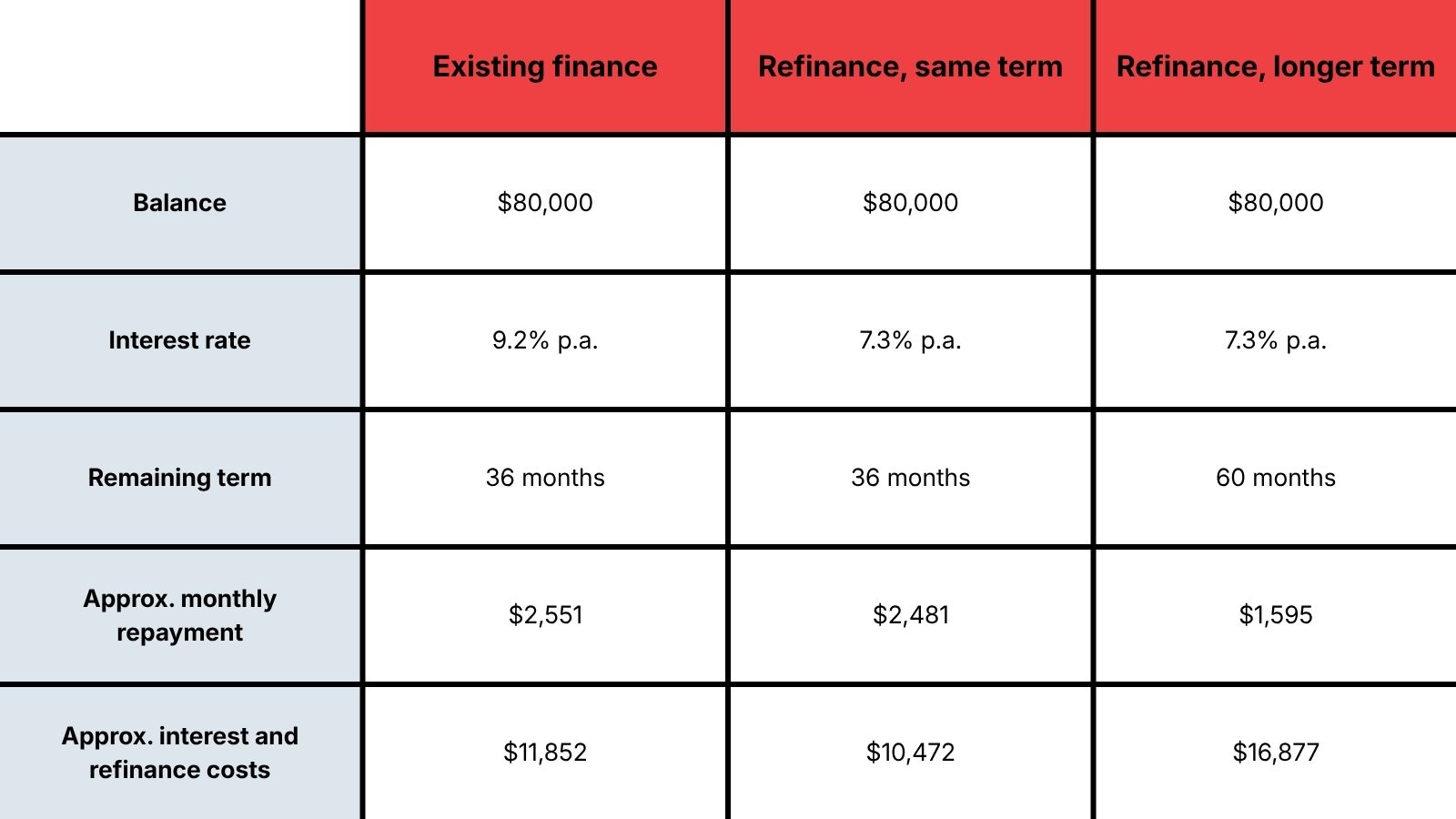
Illustrative principal-and-interest example only. It excludes tax effects, GST, balloon payments and lender-specific costs.
Keeping the 36-month term reduces the repayment by about $70 a month and produces an indicative total saving of around $1,380 after the assumed costs.
Stretching the same refinance to 60 months drops the repayment by almost $956 a month, but total interest and refinancing costs rise to around $16,877. In this example, the business gets more cash flow today but pays more overall.
That brings up one of the most useful questions to bring to any refinance discussion: are we reducing the cost, changing the cash flow, or both?
Tax and PPSR details also matter
Refinancing should not be assessed on the assumption that changing lenders automatically creates a new tax benefit.
ATO guidance says that the tax treatment of interest generally follows the purpose and use of the borrowed funds. Sometimes interest on replacement borrowing used to repay an existing income-producing loan can retain the character of the original borrowing.
Private or mixed use can change the position, so the tax treatment needs to be checked against your business’s circumstances.
The asset’s existing security arrangements matter as well.
The PPSR records security interests in assets including vehicles and business equipment, and these registrations can affect how the existing finance is paid out and replaced.
This is where finance and accounting need to stay connected. The lending decision may affect cash flow and borrowing costs, while your accountant can advise on depreciation, GST and the tax treatment that applies to your business.
How a UFinancial asset finance adviser can help
Refinancing a business vehicle or piece of equipment is easier to assess when the numbers are compared side by side.
A UFinancial asset finance adviser can help work through the existing payout amount, remaining term, interest costs, fees, balloon or residual amounts and available finance structures. The aim is to understand what changes and what does not, rather than focusing on a rate in isolation.
Frequently asked questions about refinancing business vehicles and equipment
Can you refinance a business car before the loan ends?
Yes, business vehicle finance can often be refinanced before the original term ends, depending on lender and asset requirements.
The existing lender will generally provide a payout amount, which may include early termination or administration costs. Those costs should be included when comparing your current loan with a proposed replacement.
Can you refinance a balloon payment on a business vehicle?
A balloon or residual amount may be able to be refinanced rather than paid in cash, depending on lender criteria and the vehicle’s value, age and condition.
Refinancing the amount creates a new borrowing period, so the repayment benefit needs to be considered alongside the additional interest and fees.
Can multiple business vehicles be refinanced at the same time?
It may be possible to review several vehicle or equipment facilities together, although whether they can be restructured under one arrangement depends on ownership, security, lender policy and the assets involved
Comparing the facilities together can still help you understand your business’ total asset finance commitments and repayment timing.
Is refinancing equipment the same as refinancing a business loan?
The basic idea is similar: existing debt is replaced with new borrowing.
Asset finance is different because a specific vehicle or piece of equipment may secure the debt.
A broader business loan refinance decision may instead involve working capital, property security or other business liabilities, so the assessment can be quite different.
Disclaimer: The content of this article is general in nature and is presented for informative purposes. It is not intended to constitute tax or financial advice, whether general or personal nor is it intended to imply any recommendation or opinion about a financial product. It does not take into consideration your personal situation and may not be relevant to circumstances. Before taking any action, consider your own particular circumstances and seek professional advice.

