

Managing your small business finances well comes down to three things: knowing when money comes in, what needs to go out and how financial commitments affect your business.
Cash flow forecasting, tax planning, payment arrangements and careful borrowing comparisons can all provide a clearer picture of what your business can afford.
On 3 November, the Reserve Bank of Australia raised the cash rate by 0.25 percentage points to 4.85%, the highest it’s been since 2008. If your business has variable-rate borrowing, or you’re planning to borrow, it’s a good moment to check how higher rates fit with the rest of your numbers.
Here are six practical strategies, each with simple steps you can start on this week.
1. Understand your cash flow before it becomes a problem
Even a profitable business can run short of cash. Profit and cashflow don’t always line up, especially when customers pay weeks after work has been completed.
For example, a construction business might finish a $40,000 project in November but not receive payment until January. Staff wages, supplier invoices and other expenses still need to be paid in December.
The money has been earned, but it isn’t available to cover those costs yet.
How a cash flow forecast can help
A cash flow forecast maps the money a business expects to receive against the payments it needs to make over the coming weeks or months.
It can highlight periods when expenses may exceed the cash available, giving business owners more time to understand the gap and assess their options.
Here’s a simplified three-month example for a business starting with $20,000 in cash.
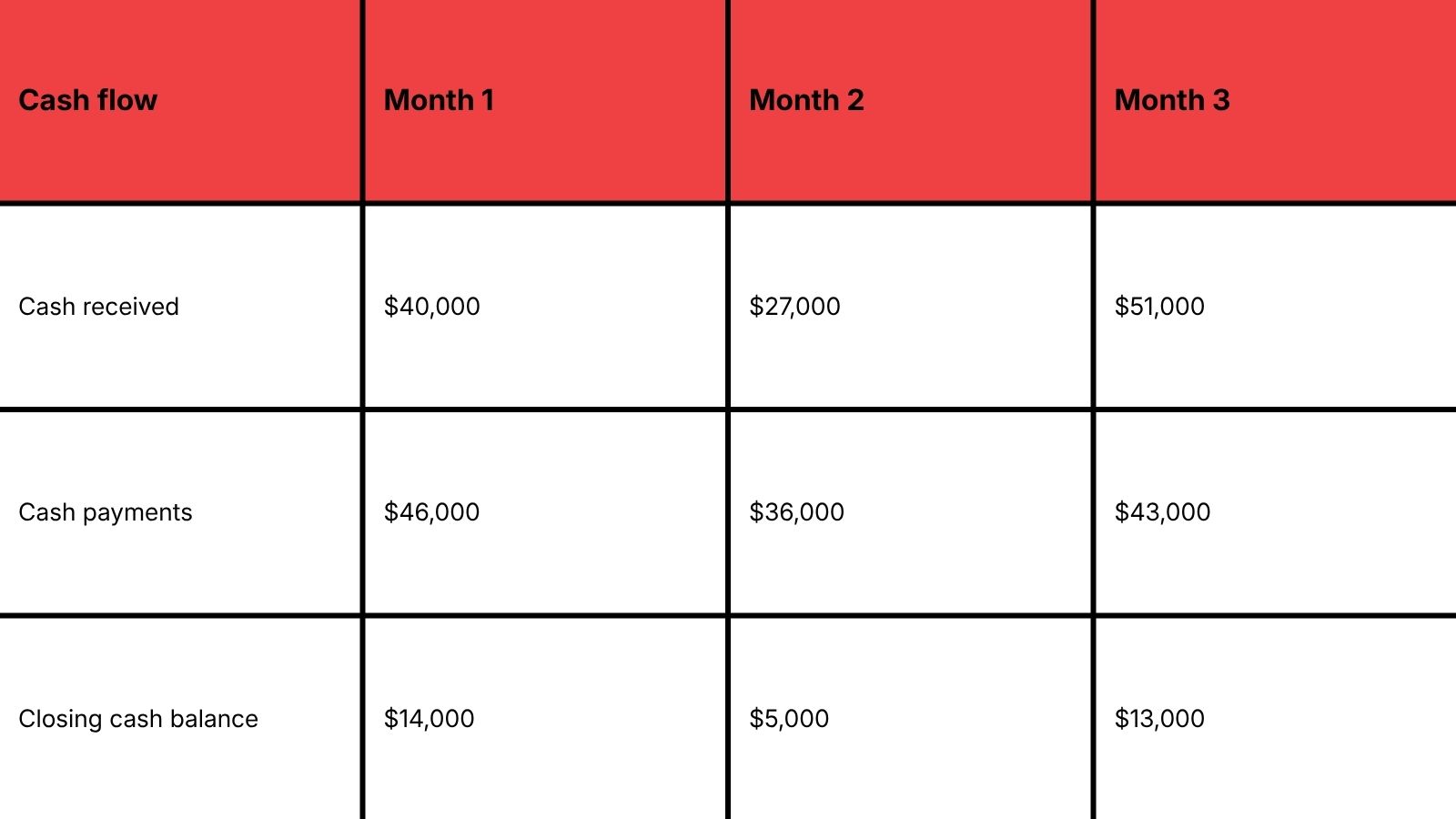
The business receives $118,000 over three months, yet its closing cash balance falls to just $5,000 in Month 2. Depending on when bills fall due, the balance could drop even further during the month.
You wouldn’t catch that by looking at revenue alone.
Steps to consider
- Set up a rolling 13-week forecast, you can find a template at the Australian Government’s cash flow statement guide
- Enter fixed payments first (wages, super, rent, loan repayments, BAS), then expected receipts based on when customers actually tend to pay.
- Highlight any week where the balance drops below a minimum you’re comfortable holding.
- Update it at the same time each week, so a shortfall shows up while you still have time to act on it.
2. Plan for tax, super and other business obligations
Not all the money in your account is yours to spend. GST, PAYG withholding and employee super can put real pressure on working capital when they aren’t planned for in advance.
Payday Super has changed the timing of payments
Since 1 July 2026, Australia’s Payday Super rules have required employers to pay superannuation each time employees are paid, rather than quarterly.
For the 2026–27 financial year, the super guarantee rate is 12% of qualifying earnings. Contributions generally need to reach the employee’s super fund within 7 business days after payday, although exceptions apply.
The overall super obligation hasn’t increased because of Payday Super, but the timing of payments has changed, which makes regular payroll forecasting more important.
The ATO’s Payday Super guidance explains the current requirements.
Steps to consider
- Some businesses keep a separate account for tax and super and move money into it each time a customer pays or payroll runs.
- Add your BAS and payroll dates to your calendar and your cash flow forecast.
- Check with your payroll provider or bookkeeper that super goes out with every pay run.
- Ask your accountant or tax adviser which obligations apply to your business, and how much to set aside for income tax.

3. Improve payment timing, not just sales
If your business has a cash flow problem, more sales won’t always solve it.
Sometimes, the bigger issue is how long customers take to pay. If your business gives customers 30 or 60 days to settle invoices but needs to pay wages and suppliers sooner, additional sales can actually increase short-term financial pressure.
Small changes can make a difference
Depending on the business and its customer agreements, payment arrangements worth reviewing include:
Steps to consider
- For larger projects, agree on a deposit or progress payments linked to clear milestones.
- Send invoices as soon as work is completed or a milestone is reached.
- Make due dates and payment methods obvious on every invoice.
- Follow up overdue accounts on a set routine, such as a reminder a week after the due date and a phone call a week later.
- Review your supplier terms alongside your customer terms.
- Plan for your busy and quiet seasons
Seasonality is another consideration for businesses across Australia.
Retailers may need to purchase stock well before Christmas sales. Tourism operators can experience large differences between peak and quieter periods, while agricultural businesses may have expenses concentrated around planting or harvest.
Higher demand doesn’t always mean more cash is immediately available, particularly when additional stock, equipment or staffing is needed first.
Including these patterns in a cash flow forecast can help clarify how much working capital may be required throughout the year.
For businesses comparing funding arrangements, a business overdraft is one example of a facility designed around fluctuating cash requirements.
Like other borrowing options, it comes with costs and conditions that can be explained by a qualified adviser.
4. Match business finance to the purpose of the expense
Business finance can help fund equipment, manage working capital or support expansion, but borrowing isn’t automatically the answer to a financial gap.
The purpose of the borrowing, the repayment structure and the total cost all matter, especially after the RBA’s November 2026 rate increase.
What higher interest rates can mean for business borrowing
The impact of the RBA cash rate on existing business finance depends on the lender, the loan agreement and whether the interest rate is fixed or variable.
For businesses with several borrowing facilities, additional interest costs can affect the amount of cash available for other expenses.
Looking beyond the advertised interest rate
Different types of business finance serve different purposes.
Term loans, overdrafts, invoice finance and asset finance can have different interest arrangements, fees, security requirements and repayment schedules.
For example, purchasing a work vehicle outright may reduce available working capital. Financing the vehicle could help you keep more cash initially, but would introduce interest, fees and repayment commitments.
Neither approach is necessarily better than the other.
When comparing finance options, it is worth asking:
- What is the total cost, including interest and fees?
- How will repayments affect cash flow during quieter periods?
- Is security required against business assets or personal property?
- Are there balloon payments, early repayment costs or personal guarantees?
- How long will the expense provide value compared with the finance term?
Steps to consider: if you have variable-rate borrowing, you may want to check whether your lender has passed on the November increase and how it affects your forecast. Before taking on new finance, it can help to test the expected repayments in your forecast and talk through the results with a finance broker or your accountant.
Speaking to an asset finance adviser can help business owners assess the differences between funding equipment and purchasing it outright.

The repayment amount is only one part of the decision. How the finance fits with existing commitments matters just as much.
5. Review the real cost of running your business
A business can be busy without making much profit.
Revenue is important, but it doesn’t show how much money remains after the costs of delivering products or services.
Expenses such as insurance, software, utilities, rent, fuel, vehicle maintenance and staffing can increase over time. If these costs rise faster than sales revenue, profit margins may become smaller.
Regular financial reviews can help business owners understand where these changes are occurring.
Some useful questions include:
- Which products or services contribute the most profit?
- Have supplier, staffing or overhead costs increased?
- Are fixed expenses growing faster than revenue?
- Does taking on additional work generate enough profit to justify the extra cost?
- How would higher borrowing costs affect the profitability of an expansion?
These considerations are especially relevant when purchasing equipment, hiring more employees or opening another location.
Growth can create opportunities, but it also brings additional financial commitments. Understanding margins helps show whether increased activity is translating into stronger business performance.
6. Keep financial records ready for future opportunities
Up-to-date financial records are useful well beyond tax time. They give business owners a clearer view of their current position and can make it easier to assess opportunities or prepare for lending discussions.
Business lenders commonly look at more than revenue when assessing an application. Cash flow, existing debts, repayment capacity, trading history and the purpose of the finance can all be considered.
What information might a lender request?
Depending on the lender and the type of borrowing, documents may include:
- Recent business financial statements and tax returns.
- Business activity statements.
- Business bank statements.
- Details of existing loans and financial commitments.
- Cash flow forecasts.
- Information about the equipment, property or business purpose being financed.
While having these documents available doesn’t guarantee loan approval, accurate records can help business owners understand their own finances before considering additional commitments.
Steps to consider:
Keep these documents in one folder and refresh it each time you lodge your BAS.
It’s also worth recognising that business and personal finances can be connected.
Personal guarantees, business debts, property loans and other obligations may affect how lenders assess future borrowing.
For owners planning to expand their business or make a personal property purchase, understanding those connections provides a clearer starting point.

How a UFinancial asset finance broker can help with small business finance
Every business has different cash flow patterns, operating costs and plans for the future. With interest rates changing and different lending structures available, understanding the costs and commitments involved can take some work.
A UFinancial asset finance broker can help you assess funding requirements, compare available lending options and understand what lenders may consider when reviewing an application.
Where relevant, UFinancial can also connect you with specialists across commercial finance, accounting and taxation, bringing the right expertise together around your business.
If you’re considering equipment finance, reviewing existing borrowing or exploring funding for growth, a conversation can help clarify the options and information relevant to your circumstances.
Book a chat or call 1800 835 626
Frequently asked questions about small business finance in Australia
Can a sole trader apply for business finance in Australia?
Yes, sole traders can apply for business finance, although eligibility depends on the lender and the type of funding requested.
Lenders may consider trading history, income, business bank statements, existing debts and other financial commitments. Some facilities may also require security or personal guarantees. Approval is not automatic, and lending requirements can differ.
Does a small business loan need to be secured against property?
No, not all business finance requires residential or commercial property as security.
Some facilities may use equipment, vehicles or other business assets as security, while others may be unsecured. However, unsecured borrowing can still involve personal guarantees or other contractual obligations. Interest rates, fees and lending conditions vary between lenders.
Are government grants available for Australian small businesses?
Government grants and support programs may be available to eligible Australian small businesses, depending on their location, industry and circumstances.
Programs can be offered by federal, state, territory or local governments. Funding amounts, eligibility criteria and application periods vary. Unlike loans, grants generally do not require repayment when their conditions are satisfied, but approval and funding are not guaranteed.
Can business borrowing affect a future home loan application?
Yes, business borrowing can influence a future home loan assessment.
Existing business debts, personal guarantees and business financial performance may be relevant to how a lender assesses income, liabilities and repayment capacity. Requirements differ between lenders, so understanding existing business commitments can be useful when considering future personal property plans.
General advice disclaimer
This article provides general information only. It does not consider any individual’s objectives, financial situation or needs and is not personal financial, taxation or legal advice. Finance eligibility and conditions depend on the circumstances and lender.
UFinancial Planning representatives are authorised by Consultum Financial Advisers Pty Ltd, ABN 65 006 373 995, AFSL 230323. Other financial products and services provided by UFinancial Pty Ltd are not authorised by Consultum Financial Advisers Pty Ltd.
Figures are current as at 6 November 2026 and may change. Worked examples are illustrative only.

