
When house prices fall, you might expect building a home to get cheaper too. It often doesn’t. According to the Australian Bureau of Statistics (ABS), house construction prices rose 5.7% in the 12 months to September 2026.
If house prices fall below what developers need to cover their costs, some projects stop making sense. Fewer homes get built, and competition for existing homes can increase. It’s one reason some people expect high building costs to hold up property prices.
The reality is less certain. High construction costs can slow future housing supply, but they can’t stop existing house prices from falling.
Knowing the difference can help you look at crash predictions more calmly and focus on what you can control: your own numbers.
Why does the cost to build a house matter for property prices?
The price of an existing house and the cost of building a new one are connected, but they are not the same.
An established property’s value depends on what buyers are willing and able to pay, shaped by location, land size, condition, comparable sales, available properties and borrowing capacity.
Building a new home involves different costs, including land, materials, labour, site preparation, professional fees, approvals and finance.
For a development to go ahead, the expected selling price needs to cover these costs and provide a return that justifies the risk.
Those costs are still rising.
ABS figures show input prices for house construction, which measure materials and other building costs, increased 3.9% in the year to September 2026, while prices charged for house construction work increased 5.7%.
So even when established property prices fall, building a comparable new home may not get cheaper. The result is a gap between what buyers can afford and what builders can profitably deliver.
What happens when house prices fall but building costs keep rising?
Imagine a developer planning to build and sell a new home.
They calculate the cost of land, construction, finance and other expenses. Based on the expected selling price, the project looks profitable.
Now imagine house prices fall by 7%, while construction costs rise by 5%.
The developer expects to earn less from the sale, but building the home has become more expensive.
Here’s how that could affect the project.
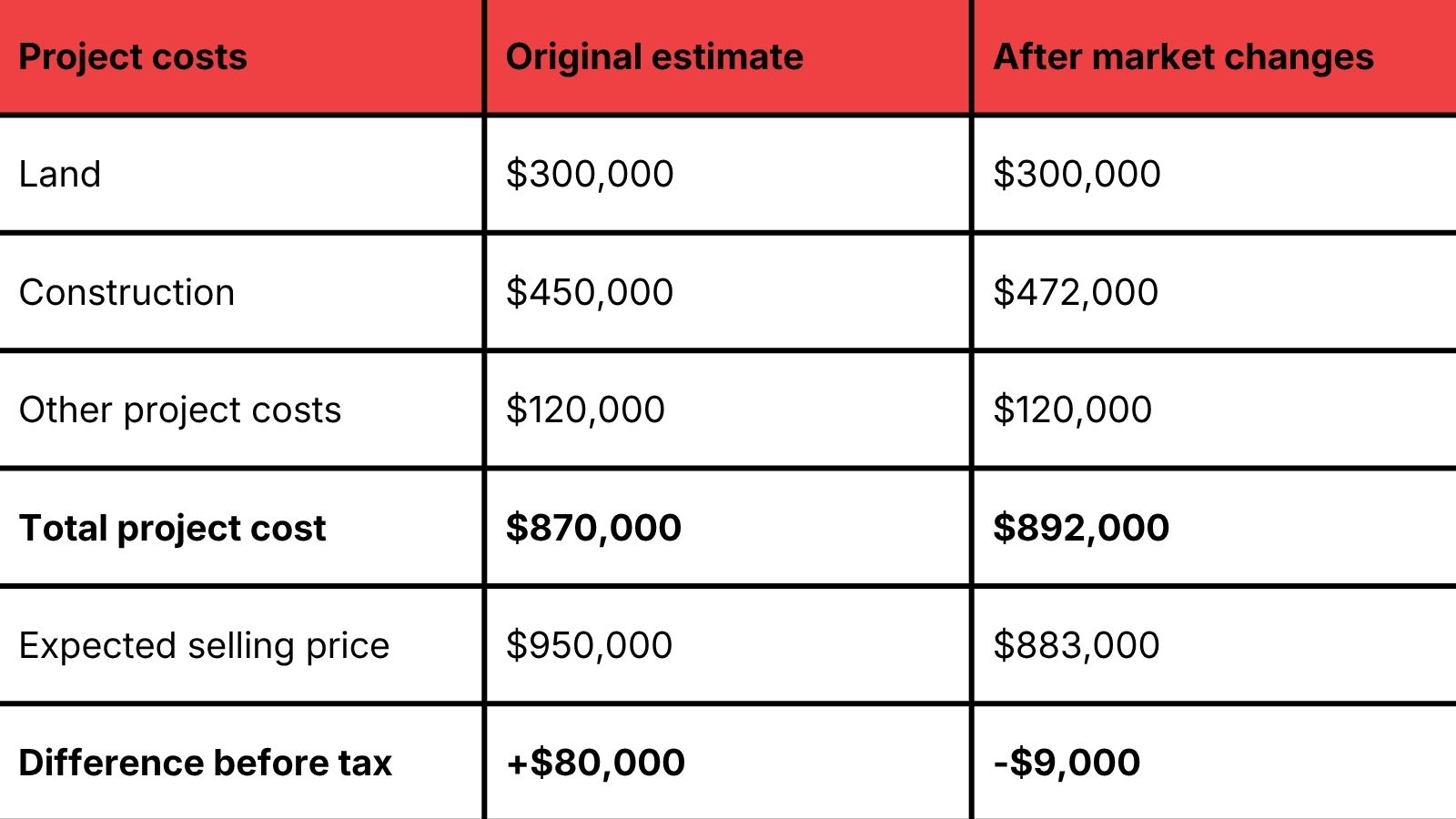
Illustrative figures only, not current market estimates. Other project costs include assumed expenses such as approvals, professional fees, finance and selling costs. Actual project feasibility also depends on tax, contingencies, contracts and other risks.
An $80,000 expected profit has become a $9,000 expected loss, and building the home may no longer make financial sense.
The developer could delay construction, negotiate a lower land price, change the design or cancel the project.
Not every developer will stop building. Some have existing contracts or financial commitments, while others may accept smaller margins or find ways to reduce costs.
However, if enough projects are delayed or cancelled, fewer new homes will be available to Australians in the years ahead.
The overlooked factor: land prices can fall even when construction costs rise
There’s one more way developers can respond: offer less for the land.
Materials, labour and other building costs may be difficult to reduce, but the price a developer is prepared to pay for land can change.
This is known as residual land value.
Put simply, developers start with the expected selling price, subtract the building costs and required profit, then calculate what they can afford to pay for the land.
If buyers won’t pay enough for the finished homes, developers may need to offer less for development sites.
So rising building costs don’t necessarily push all property values higher. They can also put downward pressure on land prices.
However, landowners may be unwilling to sell for less. When developers can’t buy land at a viable price, projects stall. So rising construction costs don’t always lead to more expensive homes. Sometimes they lead to fewer homes, and that becomes a supply problem later.
How today’s building costs can become a housing shortage tomorrow
Property prices can change quickly, but housing supply takes much longer to respond.
Before construction starts, a development may need land, planning approval, finance, construction contracts and presales. Completing the homes then takes additional time.
ABS Building Activity data for the June quarter of 2026 recorded:
- 52,201 dwellings commenced, seasonally adjusted, up 7.0% from the previous quarter.
- 47,168 dwellings completed, seasonally adjusted, up 5.8% from the previous quarter.
These figures show construction activity was increasing during that period. However, the longer-term challenge is still building enough homes to meet demand.
The National Housing Supply and Affordability Council’s 2026 report identified improvements in some housing supply measures, while continuing to highlight pressures across Australia’s housing market.
The delayed supply problem
Imagine house prices fall for an extended period.
Developers become cautious, projects are postponed and fewer new homes enter the construction pipeline.
But people still need somewhere to live, with demand driven by factors such as population growth, new households and particular locations.
If buyer confidence improves, demand can recover faster than new homes can be built. More buyers may then be competing for a limited number of established properties.
That doesn’t guarantee house prices will rise. But it shows how falling prices today can contribute to a housing shortage later.
For more on this, read our article on Australia’s housing shortage and property prices.
Can high construction costs prevent a property market crash?
No. High building costs can limit new housing supply, but they cannot guarantee that property prices won’t fall.
A property’s value ultimately depends on what buyers are willing and able to pay.
If borrowing capacity falls, unemployment rises or more homeowners need to sell, house prices can decline regardless of how expensive a new home would be to build.
An established property can even sell for less than its estimated replacement cost. Buyers aren’t necessarily comparing a property with the cost of building an identical home. They’re comparing it with other available properties and what they can afford.
Different markets also behave differently.
An inner-city apartment, suburban family home and regional house-and-land package may respond differently to interest rates, local demand and construction costs.
A national housing shortage doesn’t mean every suburb has insufficient supply or that all property values will hold.
The key distinction is that high construction costs can slow future housing supply, rather than prevent existing house prices from falling. It’s worth keeping this in mind whenever you read a prediction about a property market crash.
Why established homes can become more attractive than new builds
When building a new home becomes more expensive, established properties can be appealing.
Buyers can purchase an existing home without waiting for construction or paying separately for land, building work and associated costs.
In some areas, established homes may offer more space, larger blocks or better locations for less than the cost of building something similar.
This can increase competition for existing homes, particularly where new housing supply is limited.
However, an older property may need maintenance, electrical upgrades, roof repairs or renovations. These expenses are also affected by rising labour and material costs.
Location matters too. An established home in an area with limited housing supply may perform differently from one in a suburb with plenty of new developments.
Replacement cost helps explain demand for existing homes, but local market conditions still shape what buyers are prepared to pay.
What this means for buyers, homeowners and property investors
The impact of rising construction costs depends on the type of property you’re considering.
For buyers comparing an established home with a new build, it’s important to look beyond the advertised price.
Building costs can include site works, contract variations, finance expenses and delays. Established homes may come with renovation or repair costs.
For homeowners, higher replacement costs may support demand for comparable existing properties, but they don’t guarantee an increase in value.
For investors, limited future housing supply may support rental demand over time. However, rental income, vacancies, maintenance, holding costs and loan repayments remain important considerations.
Finance also plays a role. A home might appear good value compared with the cost of building a similar property, but that doesn’t determine how much a lender will finance.
Lenders assess borrowers and properties according to their own policies. A lender’s valuation may differ from the purchase price or estimated replacement cost.
If you’re considering building, our construction lending guide explains some of the additional finance considerations.
Rising construction costs can change the balance between new and established housing, but they don’t remove the risks of buying in a falling market or tell us when prices will reach their lowest point.
Getting clear on your own numbers
Property market trends are worth understanding, but your finances matter just as much as the direction of house prices.
If you’re comparing building with buying, considering an investment property or reviewing your home loan, a UFinancial finance broker can help you understand your borrowing capacity, loan structure, repayments and financing options.
Having a clear picture of the numbers can help you assess your options without relying on predictions about future property prices.
You can explore our home and investment loan services or book a chat or call 1800 835 626 to talk through what makes sense for you.
Frequently asked questions about building costs and house prices
Do higher building costs increase the value of existing homes?
Higher building costs can increase demand for established homes when new properties become more expensive to build. However, property values also depend on location, land, buyer demand and borrowing capacity. Rising construction costs don’t guarantee that an existing home will increase in value.
Can a house sell for less than its replacement cost?
Yes. A property can sell below its estimated replacement cost when demand is weak or sellers are under financial pressure. Market value and replacement cost measure different things. Insurance rebuilding estimates also generally exclude land, unlike the market value of a property.
Why don’t builders simply lower their prices when property values fall?
Builders may reduce profit margins or negotiate cheaper materials, but many costs can’t fall quickly. Labour, materials, finance and regulatory requirements still need to be paid for. If the expected selling price won’t cover the cost of a project, construction may be delayed or cancelled.
Are established homes always cheaper than building new?
No. It depends on location, land prices, property condition, building specifications and renovation costs. Established homes may be cheaper in some markets, while new homes may require less immediate maintenance. Comparing the total costs of both options gives a clearer picture.
General advice disclaimer
This article provides general information only. It does not consider any individual’s objectives, financial situation or needs and is not personal financial, taxation or legal advice. Finance eligibility and conditions depend on the circumstances and lender.
UFinancial Planning representatives are authorised by Consultum Financial Advisers Pty Ltd, ABN 65 006 373 995, AFSL 230323. Other financial products and services provided by UFinancial Pty Ltd are not authorised by Consultum Financial Advisers Pty Ltd.
Figures are current as at 6 November 2026 and may change. Worked examples are illustrative only.

