

If you’re thinking about buying a home but still have a HECS debt, you might be wondering whether your university degree is now working against you.
Yes, HECS debt can affect your home loan. Banks generally consider compulsory student loan repayments when assessing how much you can afford to borrow. But having HECS debt doesn’t mean you can’t get a mortgage. The impact depends on your income, other financial commitments, how close the debt is to being repaid and the lender’s assessment criteria.
Let’s break down what lenders look for, rather than assuming HECS either rules you out or makes no difference.
How does HECS debt affect your home loan borrowing power?
The main way HECS debt affects a home loan is through your borrowing capacity.
When you apply for a mortgage, banks want to understand how much of your income is available to meet home loan repayments after your existing financial commitments are considered.
This is known as serviceability, and it’s one of the central parts of a home loan assessment.
HECS, more formally known as HECS-HELP, is different from a conventional personal loan. Compulsory repayments are calculated through the tax system and depend on your repayment income.
If you’re earning enough to make compulsory HECS repayments, that money is generally considered unavailable for paying a mortgage. This may reduce the amount you’re assessed as being able to borrow.
What this doesn’t mean is that lenders simply subtract your HECS balance from what you could borrow, dollar for dollar. A $30,000 car loan or personal loan comes with set repayments that lenders factor into your monthly budget. A $30,000 HECS debt works differently: on the same income, your compulsory repayment would be the same whether you owed $30,000 or $10,000. It’s the repayment, not the balance, that shapes your borrowing capacity.
The distinction is between how much you owe and how that debt affects your ability to make repayments.
For many borrowers, HECS is one part of a much bigger financial picture. Someone with a stable income, manageable expenses and a strong deposit may still be able to secure a home loan while carrying a substantial student debt.
What do banks actually look at when you apply for a home loan?
Your HECS balance matters, but banks don’t assess it in isolation.
When applying for a home loan in Australia, lenders generally look at several parts of your financial circumstances:
- Your income: How much you earn, how consistently you earn it and the evidence available to support it.
- Your living expenses: Everyday spending, household costs and financial commitments, including expenses associated with dependants.
- Your existing debts: Credit cards, personal loans, car finance, buy now pay later arrangements and other liabilities.
- Your deposit and savings: How much you’re contributing towards the property and the funds available to cover purchasing costs.
- Your HECS repayments: How much of your income is committed to compulsory repayments and, where relevant, how soon the debt may be cleared.
- Your proposed mortgage: The loan size, repayment obligations and how those repayments would be affected by higher interest rates.
Banks also assess your ability to meet repayments using an interest rate above the rate you would initially pay. The point is to test whether you could still afford repayments if rates increase.
These different factors are why people with similar HECS debts earning the same salary could receive different borrowing assessments if one has substantial savings and very few other commitments, while the other has a car loan, credit card limits and higher living expenses.
This is why borrowing capacity isn’t shaped by your salary or HECS debt alone.

Does the size of your HECS debt matter to a bank?
It can, but often not in the way people expect.
HECS repayments are primarily determined by your repayment income rather than the total amount you owe. Two people on the same income could have similar compulsory repayments, despite owing very different amounts.
Take someone with a $10,000 HECS debt and another person with a $40,000 balance.
If both have the same repayment income, their annual compulsory repayments may be the same. The exception is when the remaining balance is smaller than the calculated repayment, in which case only the amount left owing is repaid.
Where the size of the debt becomes more relevant is in how soon those repayments are likely to finish.
Someone who is close to clearing their HECS debt may be assessed differently from someone expected to continue making repayments for several more years.
This is where lender policy becomes particularly important. Some lenders may consider the expected remaining repayment period, rather than treating every outstanding HECS balance in exactly the same way.
How much could HECS repayments affect your borrowing power?
The effect becomes clearer when you put some numbers around it.
For the 2026–27 financial year, the ATO sets the minimum compulsory repayment threshold at $69,528. For repayment income between $69,529 and $129,717, the compulsory repayment is calculated at 15 cents for each dollar above $69,528.
These are marginal repayment rates, meaning the 15% applies to the relevant portion of income above the threshold, not your entire salary.
You can check the current rules on the ATO’s study and training loan repayment thresholds page.
Example: earning $90,000 with HECS debt
For someone with annual repayment income of $90,000, the indicative 2026–27 calculation is:
$90,000 − $69,528 = $20,472
$20,472 × 15% = $3,070.80 per year
That’s approximately $256 per month committed to compulsory HECS repayments, assuming the borrower has sufficient outstanding debt.
Here’s how that compares across different balances:
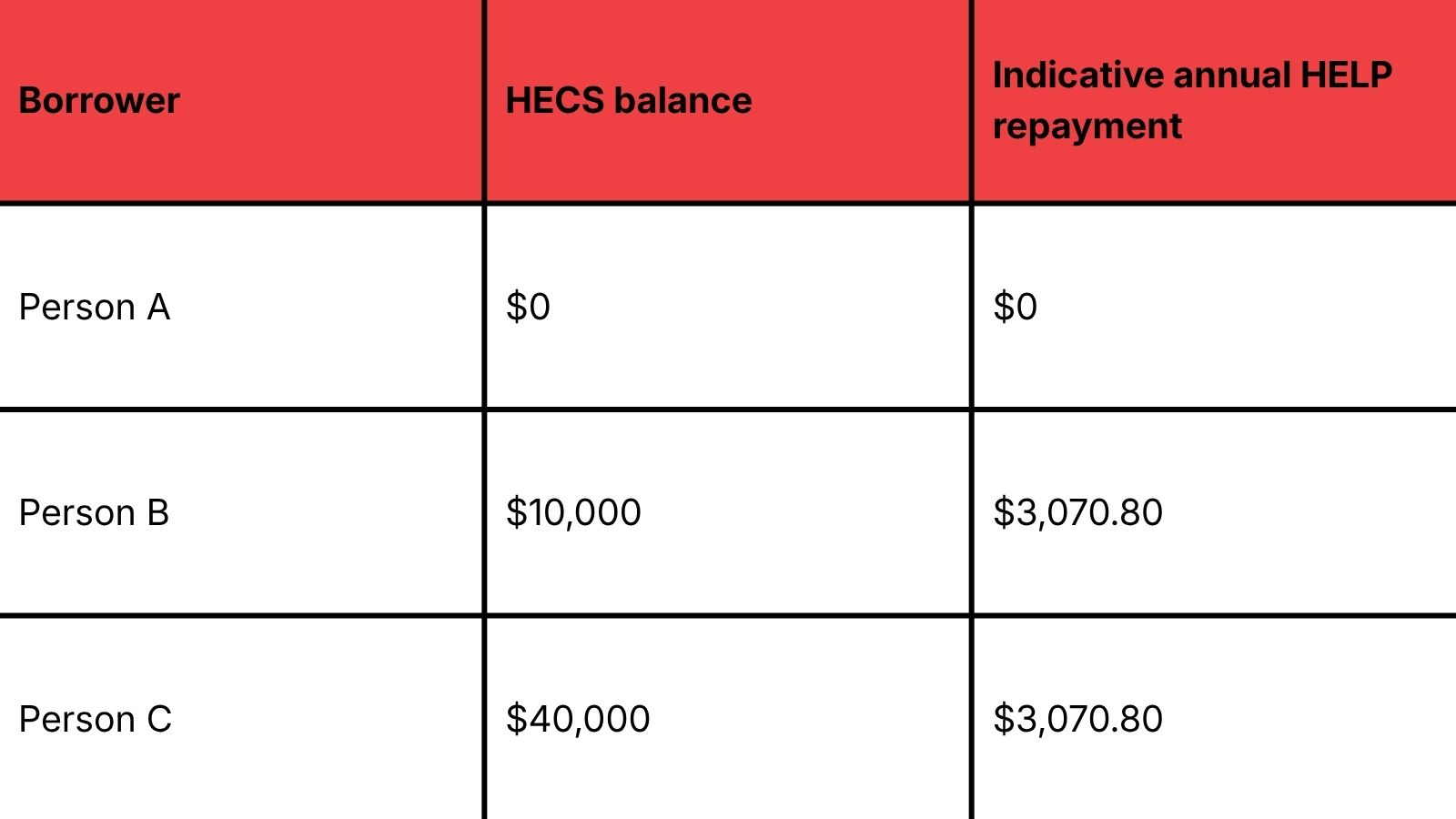
Illustrative example only. Assumes repayment income of $90,000 throughout 2026–27, with no adjustments for individual circumstances. Actual repayments are determined by the ATO, and lender assessment methods may differ.
The difference between Person A and the other borrowers is the money going towards HECS repayments rather than being available for their other commitments.
But notice something else: Person B and Person C have very different HECS balances, yet the same indicative annual repayment.
That is why a large HECS balance doesn’t necessarily mean a proportionately larger immediate impact on borrowing capacity.
The actual reduction in borrowing power isn’t a fixed amount. It depends on how the lender treats HELP repayments alongside income, expenses, other debts and the proposed mortgage.
Have the HECS home loan rules changed?
Yes, and recent changes are part of the reason there’s so much confusion about how student debt affects mortgage applications.
In June 2025, the Australian Prudential Regulation Authority (APRA) clarified how banks could assess HELP debt obligations.
Under APRA’s residential mortgage lending guidance, banks may exclude HELP repayments from a serviceability assessment in certain circumstances.
One example is where a borrower is expected to clear their outstanding HELP debt within 12 months through compulsory repayments.
However, this is an exception lenders may apply under their own policies. It isn’t a blanket rule that banks must ignore HECS debts.
APRA also changed how HELP balances are treated in banks’ regulatory debt-to-income reporting.
HELP debts are excluded from that particular reporting measure, but the distinction is important: excluding a debt from a regulatory ratio doesn’t mean its repayments automatically disappear from an individual home loan assessment.
What about the government’s 20% HECS debt reduction?
In 2025, the Australian Government introduced a one-off 20% reduction to eligible HECS debts outstanding as at 1 June 2025.
As explained by Study Assist, the reduction was applied by the ATO to eligible balances.
For borrowers who received the reduction, a lower outstanding balance could affect how long their HECS debt is expected to remain payable.
It doesn’t automatically remove the compulsory repayment obligation while debt remains outstanding, and it doesn’t guarantee an increase in borrowing capacity.
But the changes do reinforce why relying on general assumptions about how every bank assesses HECS can be misleading.
Should you pay off HECS debt before applying for a home loan?
It’s a reasonable question, particularly when buying a home is becoming a more immediate goal.
Still, paying off HECS isn’t automatically the better financial choice.
Money used to clear a student debt is money that could otherwise be available for a property deposit, purchasing costs or a financial buffer after settlement. A smaller deposit can also affect the loan amount required and potentially the costs associated with borrowing.
Additionally, making a partial voluntary HECS repayment doesn’t necessarily reduce your compulsory repayments while the debt remains outstanding. Those repayments are generally determined by income, not by making a smaller balance reduction.
For someone with a relatively small HECS balance, the implications of clearing the debt could be different from those for someone who would need to use a substantial amount of savings.
Before deciding to pay off your HECS debt entirely, consider how it would affect your whole financial position, including savings, available deposit, ongoing repayments and the lender’s assessment.

How to prepare for a home loan when you have HECS debt
Plenty of people buy property in Australia while they’re still paying off HECS. A little preparation helps you understand how it fits into your borrowing capacity, so you can go into the process with a clearer idea of what may be possible.
- Know your current HECS balance. Your ATO account through myGov can help you check the amount outstanding. If you’re close to paying it off, that information may be relevant to a lender’s assessment.
- Look at your full household budget. HECS is only one commitment. Ongoing spending, other debts, deposit savings and the repayments associated with a potential mortgage all deserve consideration. Our budget planner calculator can help organise some of those figures.
- Understand that lender policies differ. One bank’s assessment of your HECS obligations may not be identical to another’s, particularly where the balance is expected to be repaid soon.
- Consider the overall buying process. Borrowing capacity is important, but so are pre-approval, property costs, loan structure and the amount of financial breathing room you’ll have after buying. Our first home buyer guide explains the main stages in more detail.
For many people, the most useful first step is getting a clearer picture of where they stand and how HECS debt fits alongside everything else.
How a UFinancial adviser can help with HECS and home loans
HECS debt is rarely the only factor that determines what’s possible with a home loan. Your income, savings, existing commitments and the way different lenders assess repayments all play a role.
A UFinancial mortgage broker can help you understand how your HECS debt may affect borrowing capacity, work through relevant lender criteria and explore what your broader financial position could mean for your property plans.
You can learn more about our home loan services or talk through your circumstances before making any decisions.
Book a no obligation chat or call 1800 835 626.
Frequently asked questions about HECS debt and home loans
Does HECS debt affect your credit score?
HECS-HELP debt generally doesn’t appear on your consumer credit report in the same way as a credit card or personal loan, so it doesn’t directly lower your credit score. However, your credit score and borrowing capacity are different things. A bank can still ask about your HECS debt and consider the repayments when assessing your home loan application.
Can I get a home loan if my partner has HECS debt?
Yes. Couples apply for joint home loans while one or both partners are repaying HECS all the time. When you apply together, lenders will typically assess both of your incomes, expenses and financial commitments. If one or both borrowers have compulsory HECS repayments, those obligations may affect the combined borrowing assessment. The impact depends on your overall financial position and lender criteria.
What if I have HECS debt but earn below the repayment threshold?
If your repayment income is below the applicable threshold, you generally won’t have a compulsory HECS repayment for that financial year. However, you may still need to disclose your outstanding balance when applying for a home loan. A lender will assess your circumstances under its own policies, so having no current compulsory repayment doesn’t guarantee a particular borrowing outcome.
Why isn’t my HECS debt reducing with every payslip?
Amounts your employer withholds for HELP repayments generally aren’t credited directly against your student debt each pay period. The ATO calculates your annual compulsory repayment when your tax return is assessed and applies the relevant amounts then. This is why your HECS balance may not immediately reflect the money being withheld from your salary throughout the year.
General advice disclaimer
This article provides general information only. It does not consider any individual’s objectives, financial situation or needs and is not personal financial, taxation or legal advice. Finance eligibility and conditions depend on the circumstances and lender.
UFinancial Planning representatives are authorised by Consultum Financial Advisers Pty Ltd, ABN 65 006 373 995, AFSL 230323. Other financial products and services provided by UFinancial Pty Ltd are not authorised by Consultum Financial Advisers Pty Ltd.
Figures are current as at 18 November 2026 and may change. Worked examples are illustrative only.

