

Selling clothes on Depop, freelancing after work or earning a little extra through an app can be a useful source of income, especially when the cost of living is tight. But when does that extra money become taxable income?
From 1 July 2024, the Sharing Economy Reporting Regime expanded, requiring more digital platforms to report certain transactions.
This means income from activities such as food delivery, online task services and short-term accommodation is increasingly visible to the tax office.
The short answer is that extra income can be taxable from the first dollar you earn. There is no separate tax-free allowance for side hustles. However, not every payment or online sale counts as taxable income.
It all depends on what you are doing, why you are earning the money and whether your activity is considered a business, employment or a hobby.
Here is how the ATO draws those distinctions, what it can see and what extra earnings could mean at tax time.
Is there a minimum amount you can earn before extra income becomes taxable?
One of the biggest misconceptions about side hustles is that small earnings do not need to be declared.
In Australia, there is no minimum income threshold that allows someone to operate a taxable side business without reporting its income.
If money is earned through employment, business activities or another assessable source, the amount may need to be included in a tax return regardless of how small it is.
For Australian residents for tax purposes, the standard tax-free threshold is $18,200 for the 2026–27 financial year. But this applies to total taxable income, not separately to each job or income source.
As an example, consider someone earning $75,000 annually from their regular employment who also makes $4,000 in assessable profit from freelance design work. Their additional business profit generally forms part of their overall income, rather than receiving its own $18,200 tax-free threshold.
But there is an important difference between income that must be declared and the amount of tax ultimately payable.
Taxable income is calculated by taking assessable income and subtracting deductions. The tax payable then depends on the applicable rates, offsets and other circumstances.
So, earning another $500 doesn’t automatically mean owing a particular amount of tax. But assuming the first few thousand dollars of side hustle earnings are exempt can create problems later.
When does a hobby become a taxable side hustle?
The ATO looks at the nature of an activity, not simply how much money it earns.
A hobby can involve occasional sales or payments without necessarily becoming a business. However, once activities are carried out regularly, organised with the intention of making a profit, or promoted to customers, they may begin to resemble a business.
Under the ATO’s guidance on determining whether you are in business, relevant factors include whether activities are repeated, planned, commercial in nature and undertaken with an intention to make a profit.
Selling personal belongings versus selling for profit
Consider someone clearing out their wardrobe and selling unwanted clothes through Depop or eBay.
If the clothes were originally bought for personal use and are simply being sold second-hand, the proceeds would typically not be treated as business income.
Different rules can apply to certain valuable assets or collectables.
Personal use assets such as clothing are exempt from CGT if they were bought for $10,000 or less, and capital losses on personal use assets are disregarded.
Collectables (e.g. jewellery, artwork, antiques, rare coins or stamps) are only exempt if acquired for $500 or less, so selling a valuable collectable at a profit can trigger CGT even if it was never part of a business.
Now imagine someone purchases discounted clothes just to resell them at a higher price.
If they regularly buy items, advertise products, manage sales and aim to make a profit, the activity may be considered a business, even if it only operates on weekends.
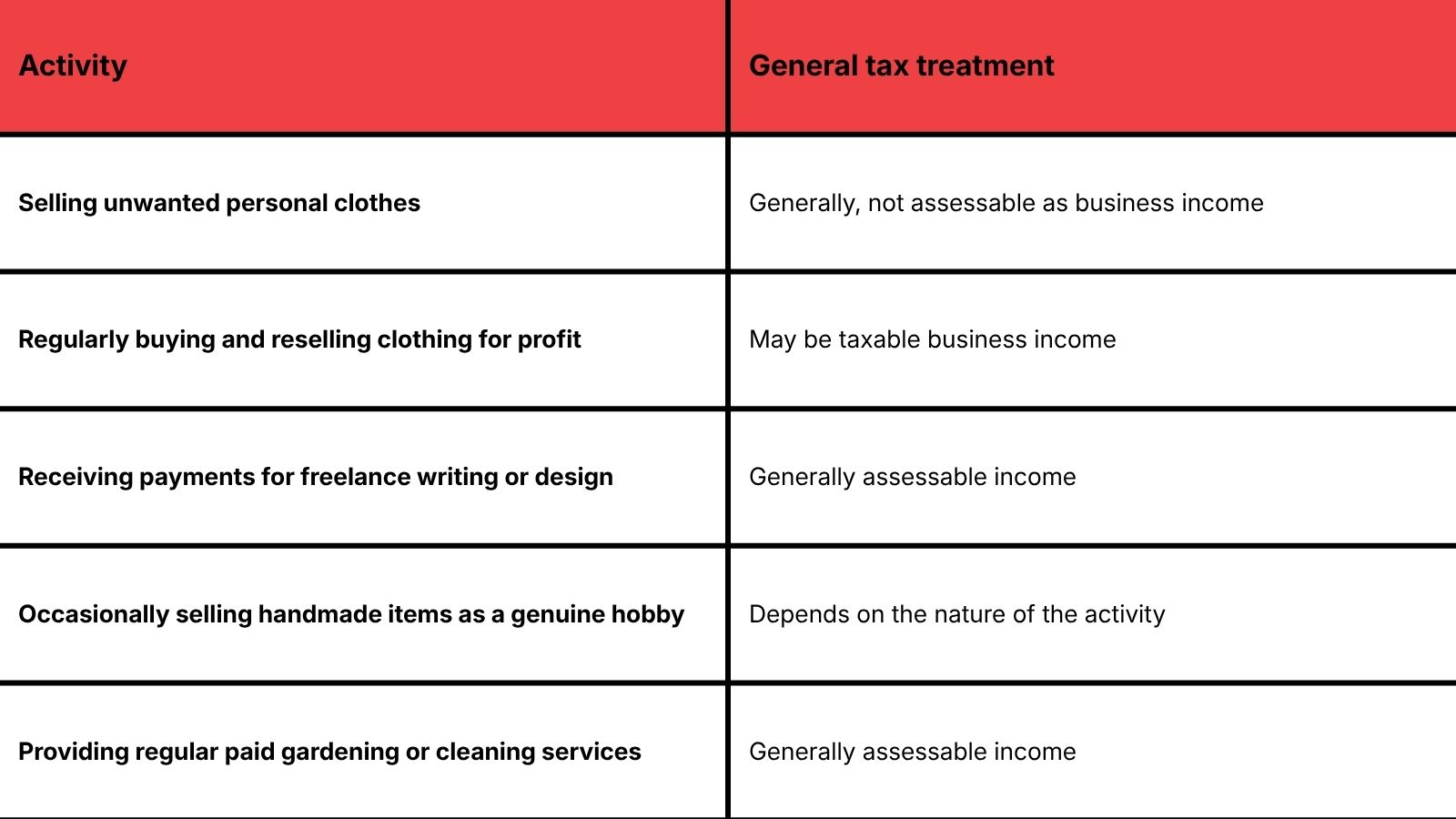
There is no fixed number of sales that automatically turns a hobby into a business. Equally, calling an activity a hobby does not make it exempt from tax.
The question is what the activity looks like in practice.
How much of your side hustle income is taxable?
Earning $8,000 from a side business does not necessarily mean you pay tax on the full $8,000.

For a business, the calculation generally begins with the income earned from selling goods or providing services. Eligible expenses incurred in earning that income may then reduce the amount included in ‘taxable income’.
Example: Someone buying and reselling clothing online while working a regular job
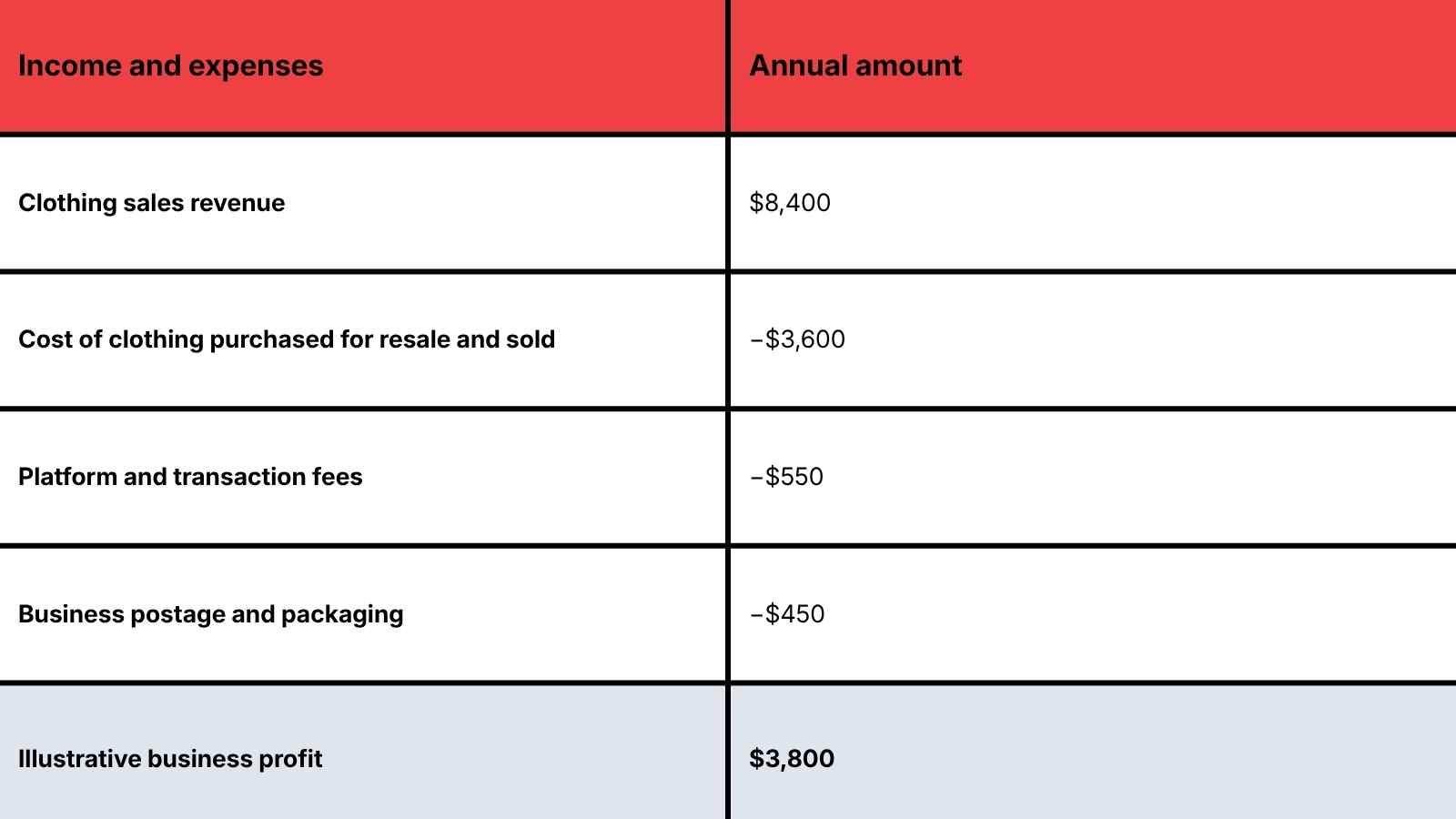
In this simplified example, the business earns $8,400 in revenue but produces $3,800 in profit before income tax.
Assuming the listed expenses are fully deductible and there are no other adjustments, the $3,800 net business income would be added to the person’s salary when working out their taxable income.
Actual calculations can be more complicated, especially when stock remains unsold at year-end, expenses have a private component or business loss rules apply.
What expenses might be deductible?
Depending on the activity, potentially deductible expenses could include:
- Platform fees
- Business supplies
- Advertising
- Business software and subscriptions
- Postage
- A share of home office running costs
- The business-related portion of certain phone or internet costs
However, personal spending does not become deductible simply because you operate a side hustle.
A phone used for work and private purposes, for example, may require expenses to be split. Similarly, purchasing everyday clothing for personal use is generally not a business deduction.
Keeping track of both sales and associated costs helps a business know the actual financial result.
How does the ATO know about side hustle income?
The ATO has access to more third-party information than many people realise.
It can compare income reported in tax returns with certain information obtained from employers, financial institutions, digital platforms and other organisations.
The Sharing Economy Reporting Regime is a significant part of this.
Reporting began for ride-sourcing and short-term accommodation transactions from 1 July 2023. From 1 July 2024, it expanded to other reportable platform services, including food delivery, asset hire, content creation and online tasking.
The regime generally does not cover outright sales of goods, such as someone selling a second-hand jacket on eBay. However, the ATO has separate online-selling data-matching arrangements that may identify other commercial selling activity.
That matters because a platform transaction being reported does not automatically mean it is taxable, but it may give the ATO information to compare against a person’s return.
Does getting paid in cash make a difference?
No. The way someone receives payment does not determine whether income is assessable.
Payments received through bank transfers, cash, digital wallets or other forms of consideration may still be taxable, depending on the activity.
This can also include products or services received in exchange for commercial work, such as an influencer accepting products as payment for promotional content.

Does a side hustle need an ABN or GST registration?
Income tax, Australian Business Numbers (ABNs) and Goods and Services Tax (GST) are separate things to consider.
Having a side hustle does not necessarily mean you need to register for GST or that you have a business.
A person carrying out a genuine hobby isn’t entitled to an ABN. An ABN is generally relevant when an activity qualifies as an enterprise. If freelancers do not quote an ABN to a business client, that client is generally required to withhold 47% of the payment.
GST follows different rules.
For most businesses, registration is required when annual GST turnover, rather than profit, reaches or is expected to reach $75,000.
There are exceptions. For example, people providing taxi or ride-sourcing services generally need to register for GST regardless of turnover.
The ATO provides further guidance on when GST registration is required.
Someone generating $12,000 every year from a small freelance business would have assessable income to declare but generally wouldn’t be required to register for GST.
In contrast, someone with substantial business sales but relatively low profit could still reach the GST registration threshold.
As activities grow, rules can change. The fact that a business begins informally does not necessarily mean its tax responsibilities remain informal.
What records matter when earning extra income?
Good record-keeping makes it easier to understand what has been earned, what has been spent and what may need to be declared.
This becomes useful when payments arrive through several platforms, expenses are partly personal or an activity develops from occasional work into regular business.
Depending on your side hustle, useful records may include:
- Sales reports and invoices showing income received
- Receipts for business-related purchases and expenses
- Platform fees, transaction charges and refunds
- Records showing how shared expenses are divided between private and business use
- Stock purchases, sales and inventory records
- Relevant business bank statements and payment summaries
Records generally need to be kept for five years from when the tax return is lodged.
A separate bank account can also make business transactions easier to separate from everyday spending, although opening one does not determine whether an activity is a business.
It is also worth understanding that additional income may not have tax withheld when it is received.
Unlike regular wages, where an employer generally withholds tax, sole traders may receive payments without any tax being deducted. This can contribute to an unexpected amount owing when their return is assessed.
Some business owners may make or be required to make pay as you go (PAYG) instalments. This allows income tax to be paid progressively rather than completely at assessment.
Planning for a possible tax bill can be part of everyday budgeting. The UFinancial Budget Planner Calculator can also show how changing income and expenses affect a household budget.
Ultimately, keeping clear records helps distinguish what was earned from what was actually kept.

How UFinancial’s accounting team can help with extra income and tax
The tax treatment of side hustle income depends on more than the amount you earn. The nature of the activity, deductible expenses, existing income and business structure can all affect the outcome.
UFinancial’s accounting and tax team can help individuals and business owners work through reporting obligations, record-keeping and tax considerations.
If additional income is also part of a future home loan application, our lending team can help explain how lenders may assess different income sources and what documentation may be required.
Book a chat or call 1800 835 626.
Frequently asked questions about taxable income and side hustles
Is money received as a gift taxable in Australia?
Personal gifts, such as birthday money from family members, are generally not treated as taxable income.
However, the circumstances matter.
A payment described as a gift may be assessable if it is compensation for work, a business activity or another income-producing arrangement.
Can a side hustle loss reduce the tax paid on a regular salary?
Not automatically.
Business losses may be subject to Australia’s non-commercial loss rules, which can restrict when losses from certain activities are offset against other income.
In some circumstances, losses must be deferred rather than deducted against salary income in the same financial year.
Is income from renting out a spare room taxable?
Generally, yes.
Receiving rent from a spare room or short-term accommodation arrangement can create assessable rental income. Related expenses may be deductible, subject to the relevant rules.
Where a family member just contributes to household costs, the ATO generally does not treat that as rental income. In that case, no deductions can be claimed either.
Renting part of a main residence can also have capital gains tax implications when the property is eventually sold.
Can earning extra income affect HELP repayments?
Yes. Earning additional income can increase your compulsory Higher Education Loan Program (HELP) repayments.
HELP repayments are calculated using your repayment income, which includes your taxable income plus certain adjustments, such as net investment losses and reportable superannuation contributions.
From the 2025–26 financial year, compulsory repayments are calculated only on income above the repayment threshold under the new marginal repayment system.
It’s also worth remembering that income from a side hustle may not have tax withheld. This means any additional HELP repayment could contribute to an unexpected bill when you lodge your tax return.
General advice disclaimer
Disclaimer: The content of this article is general in nature and is presented for informative purposes. It is not intended to constitute tax or financial advice, whether general or personal nor is it intended to imply any recommendation or opinion about a financial product. It does not take into consideration your personal situation and may not be relevant to circumstances. Before taking any action, consider your own particular circumstances and seek professional advice. This content is protected by copyright laws and various other intellectual property laws. It is not to be modified, reproduced, or republished without prior written consent.
UFinancial Planning representatives are authorised by Consultum Financial Advisers Pty Ltd, ABN 65 006 373 995, AFSL 230323.
Read the Financial Services Guide.
Figures are current as at 15 October 2026 and may change.

