

When Chris Judd took the stage at the UFinancial Annual Conference in Torquay, there was plenty of material to draw from his AFL career. He is, after all, a Brownlow Medallist, premiership captain and one of the defining players of his generation. But his conversation with UFinancial Head of Private Banking Kris Court quickly moved beyond football and into something arguably more interesting: how Judd now thinks about economic change, investing, productivity, property and the risks that come from relying too heavily on the rules of the past.
That idea — that environments change, and people get into trouble when they fail to change with them — ran through much of the discussion. It appeared in his reflections on elite sport, in the way he approaches investing through the Cerutty Macro Fund, and in his views on the Australian economy. The common thread was not prediction for prediction’s sake, but the importance of recognising when conditions have shifted and being prepared to respond before the change becomes obvious to everyone else.
When a competitive advantage stops being an advantage
One of the clearest examples came from Judd’s time at West Coast. In the early 2000s, Brisbane was the dominant side in the AFL: powerful, physical and difficult to match. Rather than trying to compete on the same terms, West Coast built its advantage around running power, recruiting and training for speed and endurance while other teams focused heavily on size and strength.
For Judd, the lesson extends well beyond football. A competitive advantage can be incredibly valuable, but only while the environment continues to reward it. He drew a comparison with Blockbuster, whose extensive store network was once the foundation of its dominance before technology transformed that same physical footprint into a costly disadvantage. The broader point was simple: sometimes organisations do not fail because they suddenly become bad at what they do. They fail because the thing they are good at matters less than it used to.

The traditional path to wealth is under pressure
That perspective is also central to Judd’s view of wealth and careers. He is sceptical of the idea that the traditional formula — study hard, earn a good salary, save diligently and gradually become financially secure — works as reliably as it did for previous generations. He spoke about highly qualified professionals working long hours and earning respectable incomes, yet struggling to achieve the housing and lifestyle outcomes that similar careers may once have delivered much more easily.
His argument was not that education or professional careers no longer matter. Rather, he believes the gap between income growth and asset prices has changed the equation, making ownership increasingly important. Whether through property, businesses or other investments, Judd sees exposure to productive or appreciating assets as a key part of maintaining purchasing power over time.
Why property matters far beyond homeowners
That naturally led into one of the most relevant topics for the UFinancial audience: Australian property. Judd is clear that equities are his preferred asset class, but his view on housing is shaped by its much wider role in the economy. Property values influence household confidence, spending, borrowing and investment decisions, while housing activity has flow-on effects across construction, employment and other parts of the private sector.
He acknowledged the affordability challenge and said he understood why policymakers might want to reduce pressure on residential property prices. His concern, however, is that housing cannot be treated as an isolated asset class without considering the broader consequences of a significant correction.

"You crunch that asset at your own peril because the flowing effects will be massive."
That was one of the sharper observations from the interview. The issue, in Judd’s view, is not simply whether property should be cheaper, but whether the second- and third-order effects of forcing prices sharply lower are properly understood. A weaker housing market may affect far more than homeowners, particularly in an economy where confidence and household balance sheets are so closely tied to residential property.
Judd also sees property through the lens of debt and currency. His view is that one of property’s structural advantages is the ability to borrow against a long-duration asset without the same margin-call risk associated with leveraged market investments. Over time, he expects the purchasing power of fiat currencies to continue declining, making long-term debt potentially attractive when attached to an asset that can hold or grow its value.
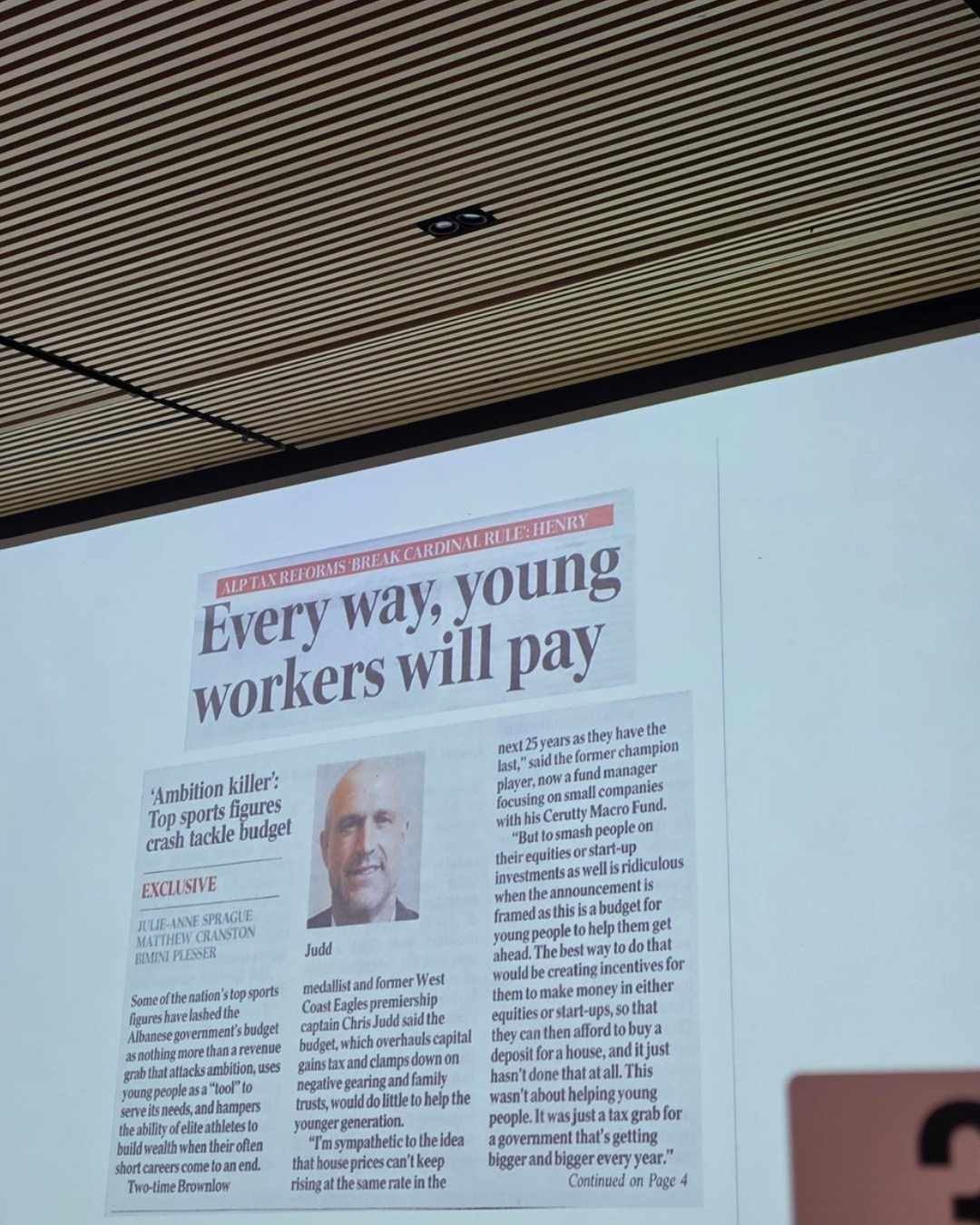 Australia’s productivity problem
The discussion then moved into one of Judd’s strongest concerns about Australia: productivity. He was openly critical of what he sees as excessive government spending, an expanding public sector and poor allocation of labour and capital. Those comments reflected his personal political and economic views, but the underlying issue he raised is broader than politics.
Productivity is ultimately about how effectively an economy turns labour, capital and resources into output. If productivity remains weak, it becomes much harder to improve living standards sustainably. Higher wages without stronger productivity can feed inflation, while governments can only spend, tax or borrow so far before the cost appears elsewhere in the system.
Judd’s frustration is that productivity can sound abstract while the consequences are anything but. Households may experience those consequences through weaker purchasing power, higher taxes, housing pressure or slower improvements in real living standards. His concern is that Australia risks trying to solve those problems through more spending rather than addressing the structural reasons productivity has weakened.
How long can higher rates really hold?
That same sensitivity underpins his thinking on interest rates. Australia’s mortgage structure means rate movements flow through to households relatively quickly, making the economy far more responsive to monetary tightening than markets where long-term fixed mortgages are more common.
Judd acknowledged that inflation remains sticky, but questioned whether headline employment figures give a complete picture of economic strength. He pointed to the role of part-time work and employment linked directly or indirectly to government funding, arguing that underlying conditions may be softer than they first appear. His view at the conference was that the next significant move in Australian rates is more likely to be down than up, although he was careful not to suggest that timing such moves is straightforward.
Conviction without rigidity
There was also an important investing lesson sitting beneath many of Judd’s observations. His approach at Cerutty Macro Fund is based on identifying large structural themes, forming a view and then remaining willing to change that view as new information emerges. It is a philosophy that requires conviction without becoming rigid.
That may be the most useful takeaway from the keynote. Judd’s sporting career taught him that preparation matters, that competitive advantages have a shelf life and that success depends on recognising what the environment demands. His investing career appears to have reinforced the same idea.
The bigger takeaway
For households, businesses and investors, the implication is not that every forecast needs to be right. It is that assumptions need to be questioned more often. The economic environment is changing, the cost of assets has changed, technology is changing how people work and governments are making decisions with consequences that can take years to become fully visible.
The risk is not simply getting the future wrong. It is continuing to make decisions based on a version of the world that no longer exists.
UFinancial would like to thank Bankwest for sponsoring Chris Judd’s keynote address and helping us bring such an engaging and thought-provoking session to this year’s conference. We also extend our thanks to Chris Judd for taking time out of his busy schedule to join the UFinancial team in Torquay, and for sharing his perspectives so openly across investing, economics, business and his career beyond football.
About Chris Judd
 Chris Judd is the Founder, Director and Portfolio Manager of the Cerutty Macro Fund. Following a 14-year AFL career, Chris moved into investment analysis and private investing, developing a macro-led investment approach focused on identifying long-term structural trends and the companies positioned to benefit from them.
To learn more about Chris and the Cerutty Macro Fund, visit the Cerutty Macro Fund website or contact the team at chris.judd@ceruttymacrofund.com.au or 03 9860 4463.
If you want clearer guidance before your next financial move, speak with UFinancial. We can help you review your lending, cash flow and broader financial position so your next decision is backed by strategy, not guesswork.

